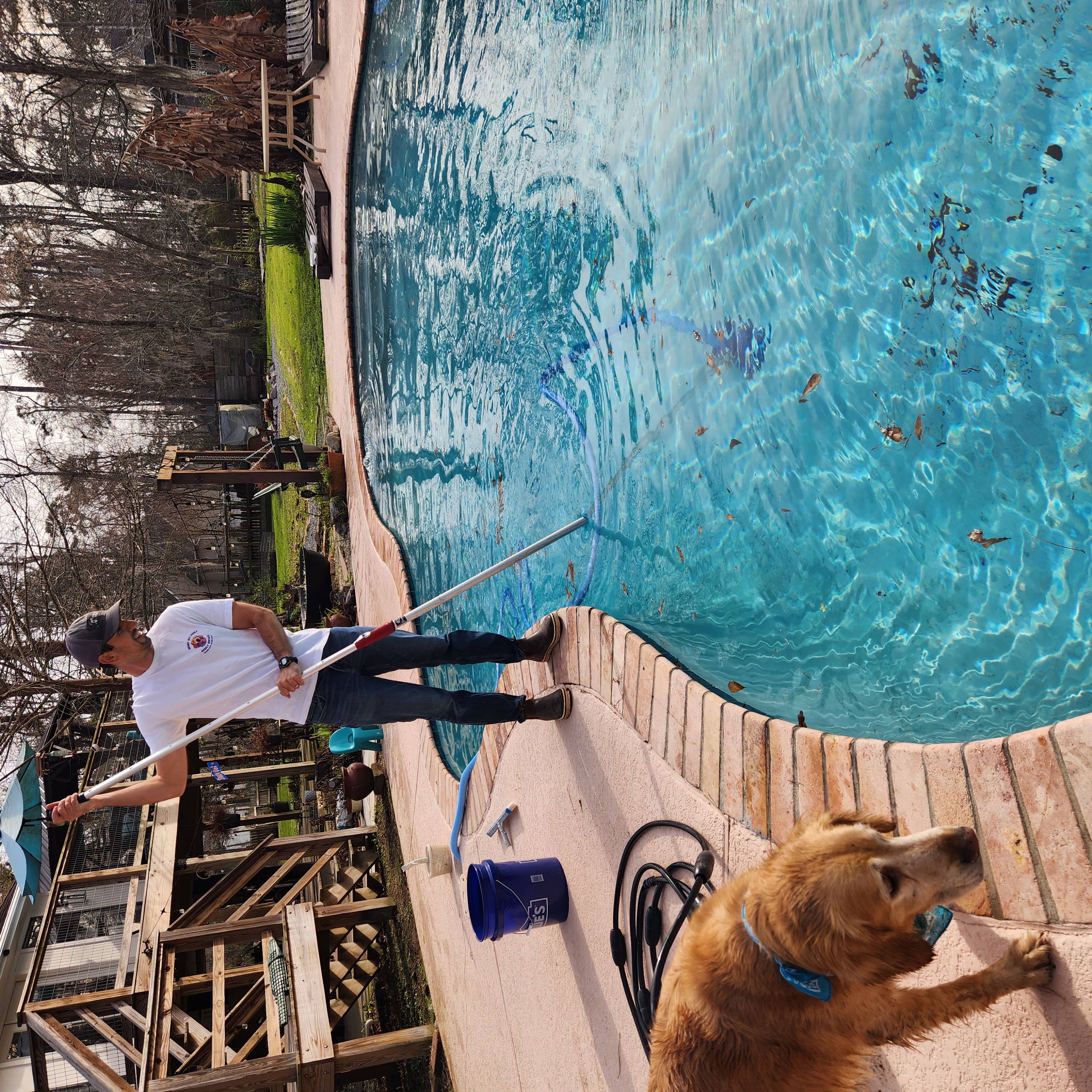
New Pool Owners Start Here
Last updated: June 2026
So you just got a brand new pool. Congratulations, also deep breath. The first few weeks can feel like a lot, with everyone (Facebook, your neighbor, every pool forum) telling you something slightly different.
This page is the short version, everything you actually need to know, broken into five simple topics, in plain language, no chemistry degree required.
A quick note on what's happening right now: if I'm handling your pool's first month as part of your builder's startup service you can relax and catch up on this at the end of the month... most new pools need close attention right out of the gate and that's what I'm here for. After that first month, if you're in my service area, you can decide whether you'd like to continue with my service or take over the care yourself. No pressure either way, I have resources to teach you if you want to take it on yourself. This page is built to be useful regardless of which route you choose.
1. Water Reading (Testing Your Water)
When you do start testing on your own, a basic test kit or test strips from any pool supply store is enough.
You don't need to fix everything right away but its good to know which direction things are moving before things get out of hand.
The following parameters are what you will test for and adjust eventually. Here is a simplified explanation of each.
Free Chlorine - sanitizes bacteria and prevents algae
pH - balanced to keep your water from being too corrosive or calcium forming (aka scale forming)
Alkalinity - reduces drastic pH swings when balanced
Calcium aka Hardness - balanced to keep water from seeking calcium (too low) or scaling (too high)
Stabilizer aka CYA - prevents chlorine from getting zapped by sunlight before it can kill bacteria.
Salt - Must be in target range for your salt cell to function optimally and produce chlorine for your pool.
Test and balance Weekly: Free chlorine, pH, and alkalinity.
Test and Balance Monthly: Calcium (aka Hardness) and Cyanuric Acid (aka Chlorine Stabilizer) and Salt
2. Water Dosing - How to Add Chemicals
Pro Tip 1: Don't Guess how much to add. (use a reference guide for your pool gallon size.)
Pro Tip 2: Pump should be running during/after adding chemicals.
Chlorine (3" Trichlor tablets) - goes in tablet feeder only - never in pool water body.
Muriatic Acid (Adjusts pH down) - dilute in water bucket then add into pool carefully (read caution labels)
Baking Soda (Adjusts Alkalinity up) - Put in pool and brush to dissolve.
Calcium - Increases Hardness - dissolve in water bucket before adding to pool, it will heat up bucket and water significantly. (exothermic)
Stabilizer/CYA - this is in the 3" trichlor tablets or can be bought separately in granular form. dissolve and disperse when dosing. Maximum of 30ppm before it will inhibit chlorine sanitation significantly.
Salt - Put in pool body and brush to dissolve. (See article on Salt Systems Here)
3. Pool Equipment Description
Every pool has a main pump, a filter (cartridges or sand), and some form of sanitation (salt system or chlorine tablet feeder). Beyond that, it varies.
Main pump - aka filter pump - has clear lid with basket inside, should be full of water when running. May be single speed or variable speed type.
Filter - large pill shaped. May be paper cartridge filter or sand filter. Check the label.
Salt System Panel and Cell - The panel can sometimes be found combined with your automation or separate, you will also see a wire running from this panel to your salt cell. Salt cell will only function and produce chlorine while your pump is running. (See article on Salt Systems Here)
Chlorine Tablet Feeder - Vertical tube with a screw on top for inserting 3" tri-chlor tablets - also has a dial for controlling how fast they dissolve. Dissolve rate will also be related to pump run time. I.e. how much water is running over the tablets and for how long. Will change with each pools chlorine demand.
Valves - should be left alone unless you have a water feature you want to shut off and no automation.
Automatic valves - these look like black boxes with handles on them attached to PVC at junctions (do not attempt to move manually)
Automation and Control Types - lets you set a timers for your equipment run times.
Analog timer: A simple dial on your equipment panel that turns the pump on and off at set times. No app or remote with this set up. Sometimes paired with a digital controller for variable speed pumps.
Jandy iQ30 (app-controlled): A smart automation panel that lets you control your pump, sanitation, heater, and any water features right from your phone. (See article on setting up IQ anetenna here)
Jandy Speed Set Controller - This is a stand alone controller mounted on the back of some Jandy variable speed pumps. You can control pump run times and full automation from this controller. It does not control other equipment like the iQ30 app.
4. Maintenance
Water level: Keep an eye on it relative to your skimmer opening. Too high, and water won't flow into the skimmer properly (plus it makes a mess on your pool deck and throws off chemistry). Too low, and your pump can run dry or start sucking air, which is hard on the equipment.
Skimmer and pump baskets: Empty them regularly — they fill up fast, especially in fall when leaves are dropping.
Filter cleaning: If you have a cartridge filter, clean it 3-4 times a year. If you have a sand filter, backwash it monthly. (Contact me to get on regular cleaning rotation if you're in South Louisiana/MS)
Salt cell (if you have a salt system): Check the cell 2-3 times a year for calcium buildup on the plates, and clean it if you find any.
Brushing: For the first month, brush the pool surfaces lightly — this helps stir up the fine dust that's normal in a brand new pool so your filter can catch it.
Pump runtime: Run the pump 12+ hours a day in summer. In winter, less is fine — the pool doesn't need nearly as much circulation when it's cold and not in heavy use.
Gas heater: Even if you're not using it much, fire it up a few times a year. It's much easier to catch a small problem early than to discover your heater doesn't work the one weekend you actually want it.
5. New Owner Tips (If You're Handling Your Own Pool Care)
This section is for owners who are not currently using my startup service, or who plan to take over their own care soon.
Don't guess on chemicals - always test before you add anything, I recommend the Taylor Test Kit 2005 for chlorine pools or 2006 if you need salt testing. It comes with a book that specifies dosing amounts.
Don't skip running the pump to "save power" - consistent circulation is what keeps the water from turning south on you.
Don't ignore the equipment panel - this is the heart of your pool. If something is leaking or the pump doesn't have water in it when running, you can shut things down until someone can take a look at it.
Weekly Checklist
Empty skimmer and pump baskets
Test Water twice per week
If you have a salt pool, check salt level and chlorine output percentage. Adjust salt cell percentage up or down based on your pools chlorine levels and demand.
If you have a chlorine pool check your chlorine tablet feeder pod. Add chlorine tablets and adjust the dial up or down based on your pools chlorine levels and demand.
Make sure skimmer openings are clear of debris and pump basket is primed and moving water before treating.
Treat pH and Total Alkalinity with Muriatic Acid and Baking Soda respectively as needed in amounts according to your pools gallon size.
Make sure water level is half way up the tile line (too full is ok it will balance out, too low may damage equipment)
Who should I call if I need something?
If it pertains to the water or equipment - call me or your local service company, if there is a problem with pool structure, tile, or design, that is a call for your builder.
Have a question that's not covered here? Reach out anytime, I'm happy to help you figure things out.
